A Brief History of Glass Block
We often recognize the beauty and functionality of Glass Block in homes and industrial settings. But, many are not aware of its beginnings.
As stated by Glass Block Technology of the United Kingdom, in the 1880’s, hexagonal bodies with arched exteriors which could be composed into honeycomb constructions, were mouthblown for partition and exterior walls. The hollow glass forms which were shaped like neckless bottles were initially worked with mortar. Great care was taken to place the open ends into the mortar in such a manner that the hollow area was hermetically sealed off against the outside air. Condensation could however seldom be prevented completely. These first mouth-blown blocks also suffered from such production deficiencies as differing wall thicknesses and thin corners.
Soon however, more robust machine-made blocks were offered by Luxfer-Prismen-Gesellschaft as well as Siemens in Dresden.
Glass block, also known as glass brick, became an effective architectural element in areas where privacy was desired while still admitting light. Areas that Glass Block was used were in underground parking garages, washrooms, and municipal swimming baths.
Their products consisted mainly of open hollow glass blocks which resembled the usual bricks in size and form. Albert Gerrer in Mulhouse was at the same time still manufacturing mouth-blown glass blocks using Falconnier process which however were sealed before the block cooled down with small glass plugs. Their form still resembled that of the hexagonal prototypes.
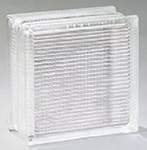 It was not until the 1930’s that the further development of machine production produced more satisfactory types which were easier to work. The Corning-Steuben block, consisting of two halves of heat-proof glass pressed together, as well as, the Owen-Illinois block became immediate precursors of the patented block of Pilkington Bros Ltd. (St Helens). Modernglass blocks are still being produced according to this principle, namely that two moulded-glass halves with a hollow interior are melted and fused together under high temperatures.
Today, the unique ambiance that Glass Block produces coupled with its functional privacy and security benefits make it incredibly popular in both residential and commercial settings.
Today, companies such as Pittsburgh Corning Glass Block produce a versatile material that can be used in a variety of ways. To see the beauty that Glass Block has evolved into, look at the popular Glass Blocks available today and their diverse designs.





 Glass Block Blogger