Posted by: glassblockblogger | June 2, 2011

Home Remodeling Economic Trends and Projections

Remodeling Trends

New York, New Jersey, Philadelphia, Boston

Companies involved in the home remodeling industry, such as we are at Eastern Glass Block, are always interested in industry projections and trends.

Economic projections show spending on home remodeling to be trending up, or at least keeping pace with GDP growth. Spending on remodeling is especially prevalent in major cities such as New York, Philadelphia, Boston, and other cities in certain coastal States.

According to a January, 2011 report called “The New Decade of Growth for Remodeling” by the Joint Center for Housing Studies of Harvard University, “Over the coming years, real spending on homeowner improvements is expected to grow at a 3.5 percent average annual pace, ensuring that the industry captures a large share of the residential investment market.” Top remodeling markets are along the coasts, such as New York, Boston and Philadelphia, to name a few major cities that have shown high spending on remodeling according to the report.

The report goes on to say that between 1995 and 2009, remodeling spending grew at a compound annual rate of 4.75 percent while the economy grew at a similar compound annual rate of 4.71 percent. Even longer term Commerce Department estimates of improvements to residential structures have closely tracked the growth in the broader economy.

The NAHB, National Association of Home Builders, provides a quarterly Remodeling Market Index for insight to current market conditions, as well as future expectations for the remodeling market.

The April 2011 Index showed a tick up to 46.5. An RMI below 50 indicates that more remodelers say market activity is lower compared to the prior quarter than those that report it is higher. The RMI has been running below 50 since the final quarter of 2005.

However, there has been an incline since the 3rd quarter of 2010 when the index was at 40.8.

Remodeling designs that meet the current desires of homeowners are critical. Those desires today include not just aesthetics, but also security and energy efficiency. Glass Block is an excellent choice when planning a practical and yet creative remodel design. Installation is easy and the decorative aspects of the material are nearly endless.

Do not hesitate to give us a call. We have over 20 years of experience designing residential and commercial projects nationwide. We love to share our knowledge.
Posted by: glassblockblogger | May 27, 2011

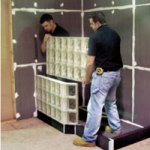
Glass Block Weekend Project, Shower, Wall, Bar, Kitchen Island

New York, New Jersey, Boston, Philadelphia

Weekend DIY Glass Block Project

The weekend is coming and it is time to plan that DIY project. Glass Block is a versatile material that can be used in a variety of ways to brighten your home. Whether you are looking to build a unique bar in the game room, a new shower, a kitchen island to enhance your open floor plan, or simply add a design element to your home, Glass Block makes it all possible. With our weekend DIY project modules, we canEastern Glass Block, New York, New Jersey, Boston, Philadelphia help you to choose the right materials and provide you with assistance on the design and installation to bring your ideas to life.

Also, you can go to our post Installing Glass Block is Easier Than You May Think. This will help you with the material options. For instance, with Pittsburgh Corning Glass Block, there is mortar or mortar-less options to make your DIY weekend even easier

Before you actually start your project, these are some questions you may have, and are also quite commonly asked;

Do I need special support underneath the wall?

Usually not. Unless there is a problem with the floor already standard subfloor framing is usually enough to support the block wall.

Can the walls be prefabricated?

Yes. Straight prefabricated walls make the project easier and less costly to perform. Rounded walls are generally built at the job site.

Are these walls sturdy? How are the walls attached or anchored?

Most block walls are tied into surrounding wall(s) using panel anchors or vinyl stack anchors every 3rd course (or 24″). Panel reinforcing or horizontal vinyl stack pieces provide additional stability.

How do you make radius or angled walls? How are the ends and tops finished off?

With the development of glass blocks with angles, corners, and finished ends there is usually no need to use dissimilar materials to finish the sides and tops of your project.

Are there blocks with 60 or 90 minute fire ratings, or ones that offer higher levels of security?

Yes. There are solid and 60 and 90 minute fire rated glass blocks with thicker faces providing increased resistance to bullets, noise reduction, improved protection against vandalism & graffiti, and better fire ratings.

Eastern Glass BlockLet us know what we can do. We have been helping DIY projects nationwide for more than 20 years from our offices in New York and New Jersey. Do not hesitate to call us.

Posted by: glassblockblogger | May 20, 2011

Glass Block in Open Floor Plans for Office and Home

The Open Floor Plan in commercial and residential designs began its popularity around the 1970s.

Commercial

Open Floor Plans in Commercial Buildings are not to be confused with the Office Desk Pools that have existed since the early 1950s. These pools of people housed a group of workers with desks lined up in rows performing similar and repetitive tasks. In contrast, the modern Open Floor Plan was designed for the purpose of team building, knowledge exchange, and productive social interaction.

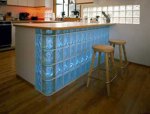
Kitchen Island, Eastern Glass BlockBefore Open Floor Plans were used in office buildings, the size of an office, for those that had one, denoted the position the employee had on the company organization chart. As one moved up to higher floors in the office building, the offices became larger. So, when an employee came home to brag about a promotion, the statement “moving up” was true in a figurative, as well as, in a physical sense.

Residential

Homes began to be designed with open floor plans during the same period as Open Floor Plans began in commercial buildings. Before that time, homes were designed with distinct and specialized rooms. The living room, dining room, and kitchen were all individual rooms, for example.

As our desire to mingle socially while cooking, eating, and watching TV at the same time, we needed the utilities and furniture to complement each other aesthetically. We also needed light to flow through this open, multi-use, space.

The challenge then became the need for a seemless integration of the different types of furniture and utilities. The look of the stove and dishwasher needed to flow through to the style of the couch and entertainment center. The need for the food preparation and serving  counter tops needed to be placed with access from both the cooking area and the eating area.

Challenge of Light

Whether we are speaking about residential or commercial use, the common challenge is light. In Open Floor Plans, light needs to be made available to all individuals no matter what part of the floor plan they are residing.

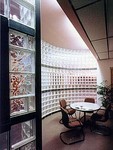
Light with Glass Block in commerical officeGlass Block has the ability to play a major role in meeting this challenge. In commercial space, Glass Block can be used to separate areas without the blocking of light to the people in that space. In Open Floor plans within a Home, Glass Block can used as a material to build Kitchen Islands with a sense of transparency to complement the open feel of the area. Glass Block can also be used in the design of living spaces to separate rooms without losing access to a source of light.

Eastern Glass Block Wall in Kitchen

We, at Eastern Glass Block, have been designing Glass Block solutions for commercial buildings and residential homes from our offices in New York and New Jersey for over 20 years. We understand the need that our customers have for light and beauty. Call us to discuss your needs. We love to share our knowledge regarding Open Floor Plans.

« Newer Posts - Older Posts »

Categories